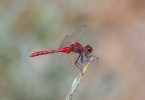
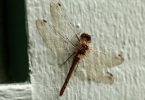
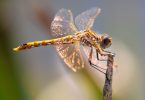
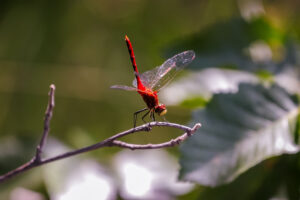
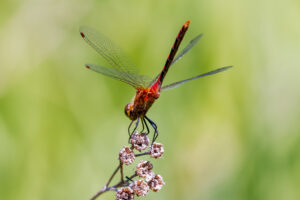
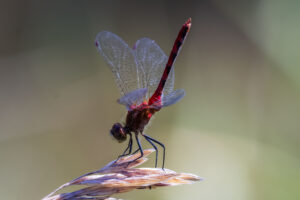
Have you ever seen a dragonfly perched with its tail pointing straight up to the sky, almost as if it’s doing a tiny insect handstand? This peculiar pose, known as the obelisk posture, is more than just a quirky behavior – it’s a brilliant survival strategy employed by these agile insects to beat the heat!
What is the Obelisk Posture?
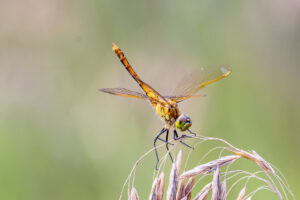
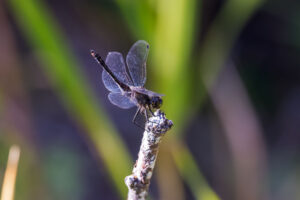
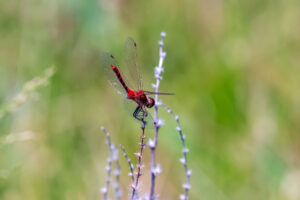
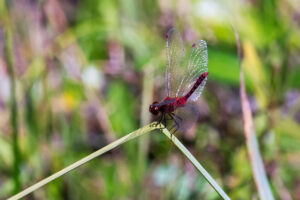
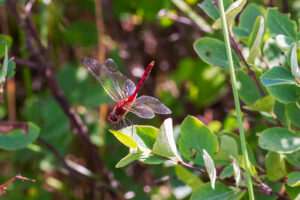
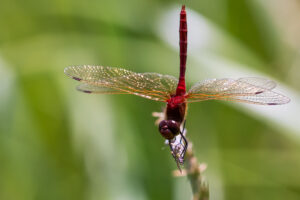
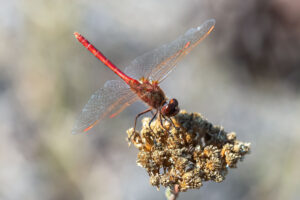
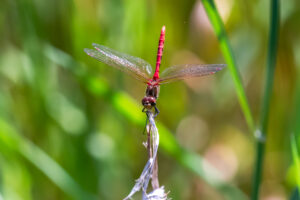
Imagine a miniature monument. That’s essentially what a dragonfly becomes when it adopts the obelisk posture. In this position, the dragonfly raises its abdomen (the long, tail-like segment of its body) until its tip points directly towards the sun. When the sun is at its highest point in the sky, around midday, the dragonfly’s body can appear almost perfectly vertical, hence the name “obelisk.”
Why Do Dragonflies Do This “Handstand”?
The primary reason behind the obelisk posture is thermoregulation. Dragonflies, like all insects, are ectotherms, meaning their body temperature is largely influenced by their environment. On scorching hot days, direct sunlight can quickly cause them to overheat.
By pointing its abdomen at the sun, the dragonfly dramatically minimizes the surface area of its body exposed to direct solar radiation. This simple yet effective maneuver significantly reduces the amount of heat absorbed from the sun, helping the dragonfly maintain a cooler, more stable internal body temperature. Studies, including laboratory experiments with species like the Blue Dasher, have even confirmed the effectiveness of this posture in preventing rapid temperature increases.
While thermoregulation is the main driver, some species might have additional motives. For instance, male Blue Dashers have been observed using an obelisk-like stance as a display of dominance or a territorial threat to rivals, showcasing the vibrant blue pruinescence on their abdomens.
Who Obelisks?
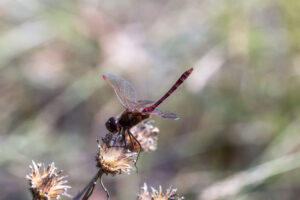
Not all dragonflies engage in this unique behavior, but it’s been observed in approximately 30 species across various families, including demoiselles, clubtails, and skimmers. It’s particularly prevalent among “perchers” – dragonflies that spend a good portion of their time stationary on a perch, waiting for prey. Species of the Sympetrum genus i.e. Meadowhawks are featured in the gallery images. Because they are often still, they have more opportunities to adjust their body position to manage their temperature.
Beyond the Obelisk: Other Thermoregulatory Tricks
Dragonflies are masters of temperature control, employing a range of strategies beyond just the obelisk:
Modified Obelisk: On hot days when the sun isn’t directly overhead, they might adopt a less extreme, partially raised abdomen.
Downward Pointing: Some species, like the dragonhunter, opt to reduce sun exposure by perching with their abdomen pointed downwards.
Wing Positioning: Certain dragonflies use their wings strategically. For example, the tropical skimmer Diastatops intensa, with its dark wings, might point its wings at the sun to reduce heat absorption. Some “saddlebags” gliders even lower their abdomens into the shade provided by dark patches on their hindwings while in flight.
Maximizing Heat: When temperatures drop, dragonflies can reverse their strategy to increase body heat. They might position their wings to reflect sunlight onto their bodies or create a “greenhouse” effect over their thorax when perched on warm surfaces. They can also orient their bodies perpendicular to the sun’s rays to maximize heat absorption.
Physiological Regulation: Beyond behavior, some larger species, like the Common Green Darner (Anax junius), can actively regulate their body temperature during flight. They achieve this by vibrating their wing muscles to generate heat and by controlling blood flow (hemolymph circulation) to distribute or dissipate heat as needed.
The obelisk posture is a remarkable example of how insects adapt to their environment. Next time you spot a dragonfly seemingly doing a handstand, you’ll know it’s not just showing off – it’s performing nature’s own sun salutation to stay cool!
References
Animal Diversity Web. (n.d.). Anax junius: INFORMATION. Retrieved July 15, 2025, from https://animaldiversity.org/accounts/Anax_junius/
BugGuide.Net. (2007, June 13). Dragonfly? Obelisk position? – Ululodes quadripunctatus. https://bugguide.net/node/view/117956
Corbet, P. S. (1999). Dragonflies: Behavior and Ecology of Odonata. Cornell University Press.
DALLAS GARDEN BUZZ. (2019, September 24). Dragonfly obelisk. https://dallasgardenbuzz.com/2019/09/24/dragonfly-obelisk/
Growing With Science Blog. (2019, October 9). Dragonfly obelisk posture. https://blog.growingwithscience.com/2019/10/dragonfly-obelisk-posture/
Johnson, C. (1962). A study of territoriality and breeding behavior in Pachydiplax longipennis Burmeister (Odonata:Libellulidae). The Southwestern Naturalist, 7(3/4), 191–197. https://doi.org/10.2307/3668841
Kids’ Inquiry of Diverse Species. (n.d.). Anax junius: INFORMATION. Biokids.umich.edu. Retrieved July 15, 2025, from https://www.biokids.umich.edu/critters/Anax_junius/
May, M. L. (1976). Thermoregulation and adaptation to temperature in dragonflies (Odonata: Anisoptera). Ecological Monographs, 46(1), 1–32. https://doi.org/10.2307/1942392
Missouri Department of Conservation. (2024, January 28). Dragonflies. https://mdc.mo.gov/discover-nature/field-guide/dragonflies
Nature Watch. (2012, July 9). Coping with the heat, or not? https://www.natureblog.org/coping-with-the-heat-or-not/
Obelisk posture. (2024, November 18). In Wikipedia. https://en.wikipedia.org/w/index.php?title=Obelisk_posture&oldid=1253456789
Powell, M. (2019, June 22). Amber obelisk. Mike Powell. https://michaelqpowell.com/2019/06/22/amber-obelisk/
Powell, M. (2020, August 5). Obelisk posture. Mike Powell. https://michaelqpowell.com/2020/08/05/obelisk-posture-2/
Red and the Peanut. (2012, March 8). A Blue Dasher dragonfly obelisking in the sun… http://redandthepeanut.blogspot.com/2012/03/blue-dasher-dragonfly-obelisking-in-sun.html
Sonoran Images. (2020, July 8). Blue Dasher — Obelisk Position. https://sonoranimages.wordpress.com/2020/07/08/blue-dasher-obelisk-position/
The Last Word On Nothing. (2020, July 17). Distractions II: This stunning dragonfly. https://www.lastwordonnothing.com/2020/07/17/distractions-ii-you-know-dasher/